Posted on

TrackIR Alternative: Is a USB Infrared Head Tracker a Smarter Choice?

TrackIR Alternative: Is a USB Infrared Head Tracker a Smarter Choice?

For years, one brand dominated virtual vision control. However, choosing a trackir alternative usb head tracker now offers superior flexibility, open software support, and far better value for simmers. Consequently, adding modern tracking hardware turns static virtual driving into an active experience for drivers.
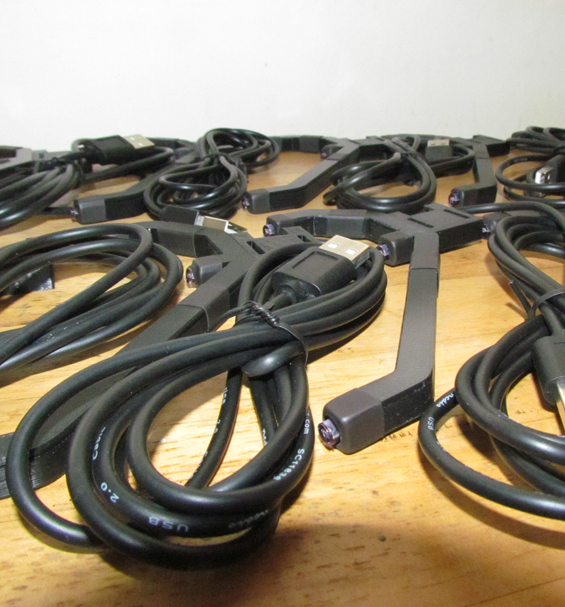
A trackir alternative usb head tracker mounted on top of a gaming monitor

As simulation tech evolves, players are searching for modern options that provide full 6DOF movement. Therefore, selecting high-precision infrared hardware gives you smooth motion without locking you into closed software ecosystems.

Key Features of a TrackIR Alternative USB Head Tracker

When upgrading your cockpit, finding a trackir alternative usb head tracker requires looking closely at performance, cost, and reliability. In addition, an ideal setup should deliver on several key fronts:

  • Seamless Motion: Enjoy smooth 1:1 rotation and translation without annoying lag or jitter during fast maneuvers.
  • Open-Source Support: Pair your clip with free community tools like OpenTrack for total curve customization across all games.
  • Affordable Pricing: Get premium precision and durable build quality without paying heavy brand markups.
  • Plug and Play Hardware: Simple USB power that runs reliably without bloated or restrictive driver suites.

Flight Sim and Racing Immersion

Whether you need head tracking for flight simulators like MSFS and DCS or sim racing titles like Assetto Corsa, high precision is essential. Specifically, using an infrared tracker provides natural view control in every virtual cockpit.

In addition, checking your side mirrors or looking into the apex of a tight corner becomes completely intuitive. Because your eyes stay focused on the track or sky, you make subtle glances naturally without losing control of your vehicle.

Long-Term Compatibility and Value

Furthermore, investing in open hardware gives you ultimate freedom across all your favorite games. Because open-source software receives frequent community updates, your device remains compatible with new simulation releases for years to come.

Therefore, picking a custom tracker is the most logical path to immersive sim gaming. As a result, you gain complete freedom and top-tier tracking at a fraction of the cost.
Posted on

Budget Head Tracker vs. Premium: Is a TrackIR Alternative Worth It?

Budget Head Tracker vs. Premium: Is an Alternative Worth It?

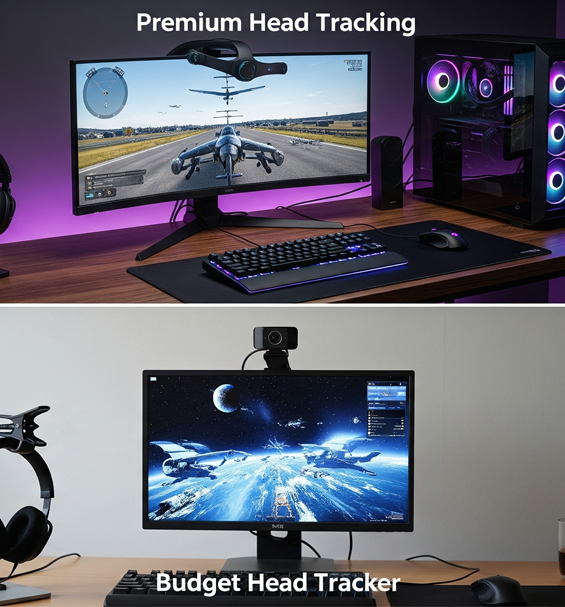
When evaluating a budget head tracker vs premium setup, software flexibility matters. Hardware reliability is also vital. Choosing open-source hardware lets simmers save money. At the same time, you retain high precision across major flight and racing titles.

A budget head tracker vs premium comparison showing tracking clips and hardware

When you are serious about simulation, head tracking is essential. For years, high-cost proprietary brands dominated the market. This leads many simmers to ask a simple question. Is an open-source clip a smart choice, or is it an unnecessary compromise?

Defining the Core Features and Differences

Typically, a commercial brand bundles proprietary software with a high price. An affordable setup relies on a simple USB infrared clip instead. It pairs with open-source tools like OpenTrack. The underlying optical hardware operates similarly in both choices. Therefore, the core difference comes down to pricing and software freedom.

Performance and Tracking Accuracy in Games

Infrared optical tracking is well established across simulation games. A durable USB infrared clip connects easily to community mapping software. Once connected, performance matches expensive commercial units. As a result, you enjoy smooth 6DOF motion during dogfights in DCS World or tight cornering in Assetto Corsa.

Furthermore, custom curves let you fine-tune deadzones and smooth out jitter. You can also tailor axis scaling to fit your cockpit view.

Budget Head Tracker vs Premium Value Verdict

Choosing an open infrared unit is a smart investment. Unbundling physical tracking points from closed software gives you an effective system for less money. In addition, replacing individual components or cables in open designs is straightforward if parts wear out over time.

Therefore, evaluating your options shows that open hardware delivers professional tracking without the brand markup. It remains the ideal choice for enthusiast simmers.

Posted on

Why a 3-Point Clip is the Most Stable Design for a Head Tracker

Why a 3-Point Clip is the Most Stable Design for a Head Tracker

Understanding why 3 point clip is best helps simmers choose reliable motion hardware. Specifically, a triangular array of infrared LEDs provides precise spatial tracking. Consequently, this design delivers smooth 6DOF movement across flight and racing simulators. Setting up proper geometry ensures your movement feels completely natural in every virtual cockpit.

Diagram showing why 3 point clip is best for infrared tracking

Ever wondered about the physical geometry behind your gaming head tracker? High-performance tracking setups rely on three infrared LEDs mounted to a headset clip. This physical layout is not a random design choice. Instead, it relies on proven mathematical principles. It remains the absolute gold standard for tracking software like OpenTrack.

The Geometry of 6DOF Movement

True 6DOF tracking requires calculating pitch, yaw, roll, and spatial translation in real time. In geometry, three non-collinear points define a rigid plane in 3D space. By tracking three distinct light points, your camera calculates exact head movement instantly. Therefore, your in-game view mirrors real motion without delay, keeping your vision locked onto targets or corner apexes.

Because the mathematical plane is locked, the software never gets confused about where your head is pointing. This geometry ensures high precision whether you lean forward to inspect dials or turn around to check your tail.

Why 3 Points Beat Other Layouts

Alternative LED layouts often struggle with 6DOF calculations during long gaming sessions:

Two-Point Setups: A two-point array cannot separate roll rotation from distance changes. As a result, moving closer to your monitor causes axis jitter, making fine adjustments frustrating.

Four-Point Setups: Extra LEDs create point occlusion issues. When you turn your head sharply left or right, one LED blocks another. This causes tracking software to lose calibration instantly.

Three points provide the exact amount of data needed for total accuracy while preventing lights from blocking each other.

Why 3 Point Clip is Best for Simulators

Using a well-built three-point IR clip paired with an IR camera offers unbeatable stability. It delivers smooth movement and zero input lag across flight and racing titles. Furthermore, unbundling hardware from closed software keeps the system affordable, durable, and simple to adjust.

Because open software lets you fine-tune response curves, you can eliminate deadzones easily. You gain total control over your view without buying expensive proprietary gear.

Ultimately, choosing this geometry ensures high accuracy and long-term reliability for your gaming rig.

Posted on

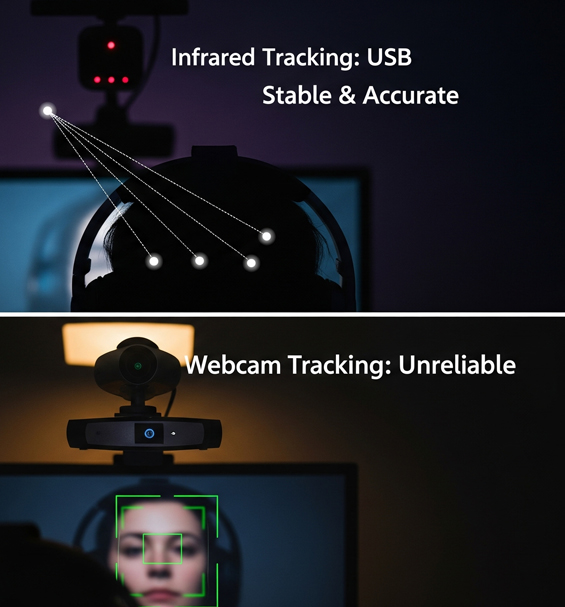
Infrared vs. Webcam Head Tracking

Infrared vs Webcam Head Tracking: Why IR is the Pro Choice

Evaluating infrared vs webcam head tracking helps gamers select reliable motion peripherals for virtual cockpits. Specifically, dedicated receivers provide high accuracy without consuming excessive system resources. Consequently, virtual pilots and sim racers enjoy smooth 6DOF control across all lighting conditions.

Infrared vs webcam head tracking hardware performance comparison diagram

When upgrading your flight or racing simulator setup, selecting the correct tracking method makes a massive difference. However, while software-based facial recognition uses standard cameras, dedicated active light arrays deliver superior stability. Therefore, understanding the structural differences between these two solutions ensures you choose the best hardware for your rig.

Webcam Performance: Convenience with Trade-offs

Standard camera tracking uses software algorithms to detect facial features like eyes, nose, and mouth. As a result, the main advantage of this approach is low entry cost, as many users already own a desktop camera.

However, processing full-color video streams requires significant CPU resources, which can reduce in-game frame rates during demanding flight or racing sessions. Furthermore, changing room light, shadows, or looking away from the camera often causes tracking loss, unexpected latency, and sudden camera jitter.

Infrared Head Tracking: Precision and Performance

An active infrared setup uses a filtered sensor paired with three active LED points mounted to your headset. Specifically, the sensor ignores visible ambient light, tracking only the distinct infrared signals emitted by your clip. Comparing these technologies highlights several distinct performance advantages:

  • Total Lighting Immunity: Active IR tracking operates flawlessly in complete darkness or bright sunlight.
  • Near-Zero System Overhead: Processing three light points requires minimal CPU usage, preserving maximum frame rates.
  • Sub-Millimeter Precision: High sensor refresh rates deliver instant 6DOF response without motion delay or axis drift.

Comparing Hardware Options for Simulation

While software tracking offers an easy entry point, active infrared hardware remains the gold standard for dedicated simmers. In addition, pairing an active IR clip with open software like OpenTrack grants complete control over response curves, deadzones, and input filtering.

Ultimately, choosing active infrared technology guarantees consistent accuracy, low latency, and long-term reliability for your cockpit setup.